From The Advocates
ADHD Awareness Month: Moving Beyond Awareness
By: Kallie Griffin-Pena, Arc Community Advocate
The new backpacks are no longer quite so new. The excitement of the first day of school has worn off, routines are settling in, and the reality of another school year is beginning to take shape.
For some families, October is when the challenges that were easy to overlook during those first few weeks become more apparent, the forgotten assignments, missing materials, difficulty getting started, constant reminders, challenging transitions, or the exhaustion let down that comes after holding it together all day.
And for families of children with ADHD, there is an important reminder:
ADHD doesn't go away when the newness of the school year does.
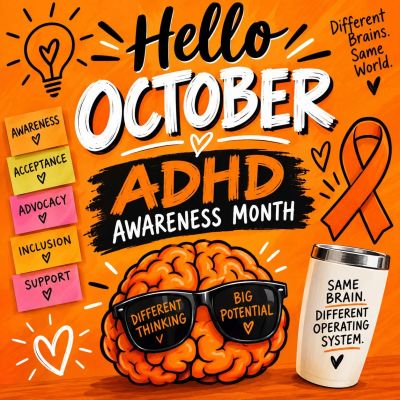
October is ADHD Awareness Month, providing an opportunity to look beyond stereotypes and better understand what ADHD can look like in the classroom, at home, and throughout a child's everyday life.
At The Arc Community Advocates, we believe awareness should lead to understanding, support, inclusion, collaboration and advocacy.
ADHD Is More Than “Not Paying Attention”
ADHD is a neurodevelopmental disorder that can affect attention, impulse control, organization, working memory, planning, time management, and other executive functioning skills. It does not look the same in every person.
A student may appear quiet and compliant while struggling significantly with organization, task initiation, remembering directions, or completing multi-step tasks.
If you've met one person with ADHD, you've met one person with ADHD.
When a student struggles, we can move away from asking, “Why won't they?” and instead ask:
“What is making this difficult, and what support might help?”
Diagnosis vs. Educational Impact
One of the questions families often have is whether an ADHD diagnosis automatically means their child qualifies for an IEP or Section 504 Plan. The answer is not automatically one or the other.
A medical diagnosis provides important information, but a medical diagnosis and educational eligibility are two different processes. Schools must consider how a disability affects a student's educational functioning and what supports the student needs.
For an IEP, a student must meet the eligibility requirements for at least one of the 13 disability categories under IDEA and demonstrate a need for special education, meaning specially designed instruction. A diagnosis by itself does not establish IEP eligibility.
Section 504 has a different eligibility standard. It focuses on whether a student has a disability that substantially limits one or more major life activities and, as a result, requires disability-related accommodations or services to have meaningful access to education.
Educational impact isn't limited to failing grades. A student may have strong academic skills while experiencing significant difficulty with organization, task initiation, attention, transitions, regulation, completing work independently, or accessing instruction.
The diagnosis is important information, but the educational impact is an essential part of the conversation.
Accommodations Are About Access
Accommodations are not about giving a student an unfair advantage or lowering expectations. They are intended to remove disability-related barriers.
An important distinction for families is the difference between accommodations and modifications: Accommodations change HOW a student accesses instruction or demonstrates learning. They may include additional time, reduced distractions, written and verbal directions, assignment chunking, organizational supports, visual schedules, transition warnings, breaks, or check-ins.
Modifications change WHAT a student is expected to learn or demonstrate. A modification may alter the content, complexity, or expectations of the curriculum. Understanding this difference is important when reviewing an IEP or 504 Plan and determining whether the supports being provided address the student's needs.
The goal isn't to make school easier. The goal is to make learning accessible.
Parents Are Part of the Team
Parents sometimes hear, “We don't see that at school.” While that observation is important, children can function differently in different environments.
Parents bring valuable information to IEP and 504 conversations. Documenting specific examples: what happened, when it happened, what support was provided, the impact, and what helped can turn general concerns into meaningful problem-solving.
And remember asking questions does not make you “that parent.”
Try asking:
- What data supports this decision?
- What supports have been tried?
- How do we know whether they are working?
- How does this disability affect my child's access to education?
At The Arc Community Advocates, we believe families should not have to navigate these systems alone. This October, let's move beyond awareness. Let's understand. Let's listen. Let's support. Let's advocate. Let's empower. EVERY student deserves to be understood for who they are, not defined by the barriers they experience.